Parallel AI Coding Agents: Why Meta Bought Conductor
Meta bought Conductor, an app that runs several AI coding agents at once. How parallel AI coding agents work, why Git worktrees matter, and what to do.
TL;DR
On 4 November 2026 Meta acquired Conductor, a Mac app that lets one developer run several AI coding agents at the same time, each in its own isolated copy of the code. The deal shows where coding tools are heading: from one assistant you chat with to a small team of agents you manage. Conductor Cloud shuts down on 20 November, so current users should export their data now.
Key takeaways
- Meta acquired Conductor, an AI coding startup formally named Melty Inc., on 4 November 2026; the price was not disclosed, and Meta confirmed the deal to TechCrunch without further comment.
- Conductor lets a developer run several coding agents, such as Claude Code, Codex and Cursor, in parallel, each in an isolated workspace, and then review and merge their work.
- Under the hood, each Conductor workspace is a Git worktree with its own branch, a standard Git feature anyone can use.
- Conductor Cloud becomes read-only on 13 November 2026 and shuts down on 20 November 2026; the local Mac app stops getting new models and critical bug fixes in early 2027.
- Conductor says more than 100,000 people use it, and it raised a $22 million Series A in March 2026 from Spark Capital and Matrix.
Parallel AI coding agents are the idea behind this week's most interesting developer-tools deal. On 4 November 2026, Meta acquired Conductor, a small startup whose Mac app lets one developer run several AI coding agents at once, each on its own task and in its own copy of the code. Here is what happened, how the approach works, and what it means for you.
What happened with Meta and Conductor?
Axios first reported the deal, and Conductor confirmed it on its website. CEO Charlie Holtz wrote that Conductor is joining Meta and promised customers "something new" early next year. Meta confirmed the acquisition to TechCrunch but declined to share terms or comment further.
Some background, according to TechCrunch and SiliconANGLE:
- Conductor (formally Melty Inc.) was founded in 2024 by Charlie Holtz and Jackson de Campos, and launched its core product in summer 2025.
- It says more than 100,000 people use it. Meta engineers were already among them.
- It raised a $22 million Series A in March 2026 from Spark Capital and Matrix, with Y Combinator and the founders of Notion and Linear also backing it.
- Holtz said on X that he looks forward to working with Alexandr Wang, Meta's chief AI officer, and Nat Friedman, who leads product at Meta Superintelligence Labs.
People familiar with the deal told Axios, as cited by SiliconANGLE, that Meta expects the team's speed of shipping to help build its next generation of AI coding tools. Meta already has its own coding agent, Muse Code, which TechCrunch says launched in August.
What are parallel AI coding agents?
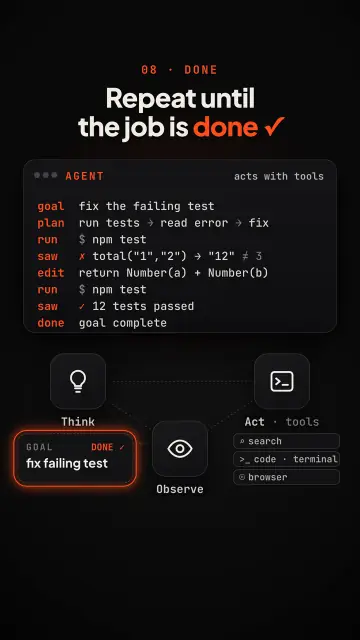
A coding agent is an AI system that does not just suggest code. It reads your project, edits files, runs commands and tests, and loops until the task is done. Claude Code from Anthropic, Codex from OpenAI and Cursor are well-known examples. If the word "agent" is new to you, our 30-second AI agents explainer reel shows the plan, act, check loop.
Parallel AI coding agents means running several of these at the same time. Instead of one assistant fixing a bug while you wait, you might have:
- agent 1 fixing the login bug,
- agent 2 writing tests for the payments module,
- agent 3 trying a new design for the settings page.
You stop being the person who types every line and become closer to a reviewer or team lead. One engineer quoted in Conductor's Series A post put it this way: much of their work is now "wildly parallelized."
How does it work in plain English?
The hard problem is collisions. If three agents edit the same folder at once, they overwrite each other's changes and nobody can tell which edit broke what.
Conductor's answer is isolation. Its documentation says that when you create a workspace, Conductor creates a Git worktree for it and checks out a branch inside it. A Git worktree is a second (or third, or tenth) working folder linked to the same repository, each with its own branch. They share the project's history but have separate files on disk.
So the flow looks like this:
- You describe a task.
- Conductor makes a new worktree and branch, usually under
~/conductor/workspaces/<repo>/<workspace>. - An agent works only inside that folder.
- You review the result and merge the branch you like.
There are a few catches that the docs point out. A new worktree only contains files Git tracks, so things like .env files are missing, and Conductor added a "Files to copy" setting for those. Git also allows a branch to be checked out in only one worktree at a time.
Conductor Cloud went further: according to SiliconANGLE, it ran agents in sandboxed virtual machines that could work for hours, with an iPhone app to check on them.
| One assistant | Parallel agents | |
|---|---|---|
| Tasks at a time | One | Several |
| Where the code lives | Your main folder | One isolated worktree per task |
| Your role | Pair programmer | Reviewer and merger |
| Main risk | Waiting | Too much code to review well |
Why does this deal matter?
Coding tools are becoming agent managers. The race is no longer only about which model writes the best code. It is about who builds the best place to hand out work, watch it and merge it. Conductor did not build its own models; it ran agents from other labs, and users paid for those through their own subscriptions.
Big labs are buying the workflow layer. On the same day, OpenAI said it plans to acquire Pierre Computer, a developer-tools startup whose open-source Trees and Diffs libraries already sit inside Codex, according to SiliconANGLE. Both deals are about the tooling around agents, not just the agents.
Small tools can vanish fast. Conductor users got about two weeks' notice before the cloud service shuts down. If your workflow depends on a startup's cloud, that is a real risk.
What happens to Conductor users now?
Conductor's announcement sets out the timeline:
- 4 November 2026: new sign-ups and downloads stopped; current Pro users keep Pro features at no cost.
- 13 November: Conductor Cloud becomes read-only. You can read and export, but not send new messages. Active subscribers get a refund.
- 20 November: Conductor Cloud shuts down and deletion of cloud data begins.
- Early 2027: the local Mac app stops receiving new models and critical bug fixes.
To keep your work, right-click a cloud workspace and choose "Transfer to local", or export everything from Settings → Account → Export data. Conductor says it has never sold or trained on user data.
What should you do?
- If you use Conductor Cloud: export or transfer your workspaces before 13 November, to be safe, and certainly before 20 November.
- Try the pattern with plain Git. Run
git worktree add -b fix-login ../myapp-loginto get a second folder on a new branch, then start your agent of choice inside it. Repeat per task. Clean up withgit worktree remove. - Start with two agents, not ten. Every agent's output is code you must review. Agents can be confidently wrong (our AI hallucination reel explains why), so keep tests and code review as the gate.
- Give each agent a small, clear task that touches different files. Overlapping tasks lead to painful merges.
- For students and job seekers: learn Git branching and code review well. Managing several agents makes those skills more valuable, not less.
Want help setting up AI agents that actually ship work for your team? Start a project with byagents.
Researched and drafted with AI agents by byagents, fact-checked against the sources above. Edited by Yashvanth S.
Frequently asked questions
What are parallel AI coding agents?
Parallel AI coding agents are several AI coding assistants working on the same project at the same time, each on a separate task. A developer hands out the tasks, lets the agents work, and then reviews and merges the results. Tools like Conductor organise this so the agents do not overwrite each other's files.
What did Meta buy?
Meta bought Conductor, a startup founded in 2024 by Charlie Holtz and Jackson de Campos. Its Mac app runs agents such as Claude Code, Codex and Cursor in isolated workspaces. The deal terms were not disclosed.
What happens to Conductor users?
New sign-ups and downloads stopped on 4 November 2026, and current Pro users keep Pro features for free. Conductor Cloud goes read-only on 13 November and shuts down on 20 November, after which cloud data is deleted. The local app keeps working until early 2027.
What is a Git worktree?
A Git worktree is an extra working folder attached to the same Git repository, with its own branch checked out. It lets you have several branches open on disk at once without cloning the repository again. Conductor creates one worktree per agent workspace.
Do I need Conductor to run agents in parallel?
No. The core idea relies on plain Git: create a worktree per task with git worktree add, and start an agent in each folder. Conductor added a dashboard, review tools and cloud machines on top, but the basic workflow works without it.
Sources
- Meta acquires AI coding startup Conductor, TechCrunch, 4 November 2026
- Meta acquires AI coding startup Conductor, whose app runs several coding agents at once, SiliconANGLE, 4 November 2026
- Conductor is joining Meta (announcement), Conductor, 4 November 2026
- Git worktrees (Conductor docs), Conductor, 6 November 2026
- Conductor Series A, Conductor, 30 March 2026
- OpenAI to acquire developer tooling startup Pierre Computer, SiliconANGLE, 4 November 2026
- git-worktree documentation, Git, 6 November 2026
Researched and drafted with AI agents, fact-checked against the sources above, and reviewed by Yashvanth S.