What Are AI Agents? A Plain-English Guide (2026)
AI agents are AI systems that plan, use tools and act on their own to finish a goal. How they work, where they help, and what to watch out for.
TL;DR
An AI agent is a system built around a large language model that decides its own steps toward a goal: it plans, calls tools such as search or APIs, checks the result and repeats until the job is done. A chatbot answers you; an agent acts for you, which makes it more useful and also riskier, so good agents ship with limits and human checkpoints.
Key takeaways
- Anthropic separates workflows, where code fixes the steps, from agents, where the model decides its own steps and tool use (Building Effective Agents, December 2024).
- The core loop of most agents is reason, act, observe, a pattern formalised in the ReAct paper by Shunyu Yao and colleagues in October 2022.
- IBM lists four parts that make a model an agent: planning, tools, memory and reasoning.
- The Model Context Protocol (MCP) is an open standard for connecting AI apps to tools and data, often described as a USB-C port for AI.
- Agents cost more and fail in new ways, such as looping on the same tool, so builders add iteration limits, logs and human approval for high-impact actions.
What is an AI agent?
An AI agent is a system built around a large language model (LLM) that works toward a goal by deciding its own next steps. You give it an outcome ("find the cheapest flight on Friday and hold it"), and it plans, uses tools, checks what happened and keeps going until the job is done or it needs you.
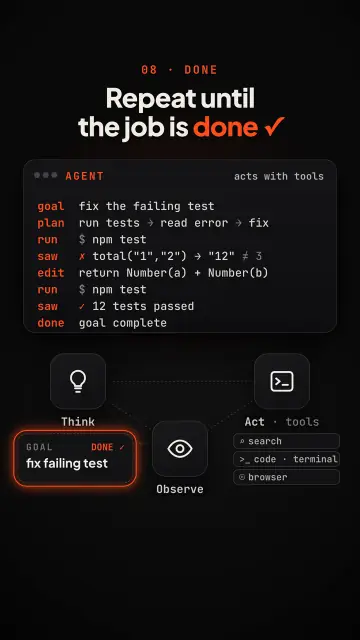
That last part is the whole difference. A normal chat with a model is one question and one answer. An agent runs a loop, and inside that loop it can do things in the world: search the web, call an API, read a file, run code, send a message.
If you have watched our 30-second explainer on AI agents, this is the long version.
How is an AI agent different from a chatbot?
A chatbot answers. An agent acts.
| Chatbot | AI agent | |
|---|---|---|
| What it does | Replies to your message | Works toward a goal |
| Steps | One response | Many steps in a loop |
| Tools | Usually none | Search, APIs, code, files, other agents |
| Who decides the steps | You, one prompt at a time | The model, within limits you set |
| Typical risk | A wrong answer | A wrong action |
Real products sit on a scale between the two. A support bot that can look up your order and issue a refund is already partly an agent.
Anthropic draws a useful line in its engineering guide Building Effective Agents (December 2024). It calls everything in this space "agentic systems", then splits them in two. Workflows run the model and its tools along steps that the developer fixed in code. Agents let the model choose its own steps and tool calls as it goes.
How do AI agents work?
Most agents follow the same rhythm: think, act, observe, repeat. This pattern was formalised in the 2022 paper ReAct: Synergizing Reasoning and Acting in Language Models by Shunyu Yao and colleagues. ReAct has the model write a short piece of reasoning, take an action (such as a search), read the result, and use it to decide the next move. Mixing reasoning with real actions helped the model correct itself instead of confidently guessing.
IBM's overview of AI agents breaks the machinery into four parts:
- Planning: splitting a goal into smaller subtasks.
- Tools: reaching outside the model for fresh data or abilities, such as web search, databases or other agents.
- Memory: keeping track of past steps and feedback so it doesn't repeat mistakes.
- Reasoning: the strategy that ties it together, from step-by-step loops like ReAct to planning everything up front.
Anthropic calls the basic building block an augmented LLM: a model given retrieval, tools and memory, so it can write its own search queries, pick the right tool and decide what to remember.
What are "tools", exactly?
A tool is any function the agent is allowed to call, with a name, a description and inputs. "get_weather(city)" is a tool. So is "run_sql(query)" or "send_email(to, body)". The model doesn't run anything itself; it asks for a tool call, your code runs it, and the result goes back into the loop.
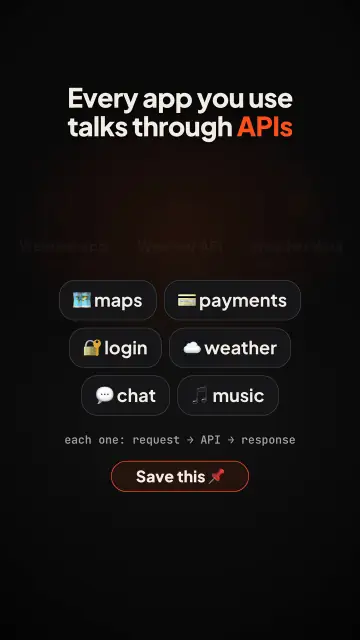
If APIs are new to you, our explainer What is an API? covers the idea with a restaurant.
What is MCP?
The Model Context Protocol (MCP) is an open standard for connecting AI applications to outside systems: data sources like files and databases, tools like search engines, and ready-made workflows. Its own documentation compares it to a USB-C port for AI: build a connector once, and any app that speaks MCP can use it. Assistants such as Claude and ChatGPT and editors such as Visual Studio Code and Cursor support it, which is why it shows up in so many agent tutorials.
What can AI agents actually do?
Agents are most useful when a task has many steps, needs fresh information, and the path isn't fixed in advance. Common examples:
- Customer support that can look up an order, check a policy and draft the fix.
- Coding assistants that read a codebase, edit files, run the tests and try again when they fail.
- Research that searches, opens sources and writes a summary with links.
- Voice agents that answer phone calls, qualify the caller and book the next step.
- Operations that move data between apps and flag what needs a human.
Teams also chain several agents: one plans, others carry out parts, and another checks the result. The OpenAI Agents SDK, for example, is built around a few such primitives: agents (a model with instructions and tools), handoffs or "agents as tools" for delegating to another agent, guardrails that validate inputs and outputs, and built-in tracing for debugging.
What are the risks and limits of AI agents?
Agents fail differently from chatbots, because a mistake can turn into an action.
- Cost and speed: many model calls per task add up. Anthropic's advice is to start with the simplest thing that works, often a single well-prompted call, and add agent behaviour only when it clearly helps.
- Loops: IBM notes that agents can get stuck calling the same tool again and again.
- Cascading errors: in multi-agent systems, one bad step can spread, especially when every agent relies on the same underlying model.
- Privacy and security: an agent with access to your email or database needs the same care as an employee with those keys.
The fixes are mostly ordinary engineering: test in a sandbox, cap the number of steps, keep logs of every action, design tools so mistakes are hard to make, and require a human's approval for anything expensive or irreversible.
How can you start using AI agents?
- Pick one narrow, repetitive task with a clear "done", such as triaging support emails.
- Try a workflow first. If fixed steps work, you may not need an agent at all.
- Give the agent few, well-described tools, and test how it uses them.
- Add limits and a human checkpoint before it can do anything costly.
- Measure it against how the task is done today.
That is exactly how we work at byagents: many agents, one intent, and a human reviewing every detail. If you want an agent built for your business, start a project.
Frequently asked questions
What is an AI agent in simple terms?
An AI agent is software that uses a language model to work toward a goal on its own. Instead of giving one answer, it plans steps, uses tools like search or an API, looks at what happened and keeps going until the task is finished or it needs your help.
What is the difference between a chatbot and an AI agent?
A chatbot replies to messages; it talks. An agent takes actions: it can look things up, fill in a form, write and run code or book something, then check the outcome. Many products mix both, so think of it as a scale from answering to acting.
Are AI agents safe to use?
They are as safe as their limits. Because agents act, a mistake can do more than a wrong sentence. Good setups test agents in sandboxes, cap how many steps they can take, log what they do and ask a human before anything costly or irreversible.
Do I need to code to build an AI agent?
Not always. No-code tools let you connect a model to apps and data. For custom agents, developers use frameworks such as the OpenAI Agents SDK, and standards such as the Model Context Protocol to plug in tools.
What are AI agents used for today?
Common uses include customer support that can look up orders, coding assistants that edit and test code, research assistants that search and summarise, and voice agents that answer calls and book appointments.
Sources
- Building Effective Agents, Anthropic, 19 December 2024
- ReAct: Synergizing Reasoning and Acting in Language Models, arXiv (Yao et al.), 6 October 2022
- What are AI agents?, IBM
- What is the Model Context Protocol (MCP)?, Model Context Protocol
- OpenAI Agents SDK, OpenAI
Researched and drafted with AI agents, fact-checked against the sources above, and reviewed by Yashvanth S.